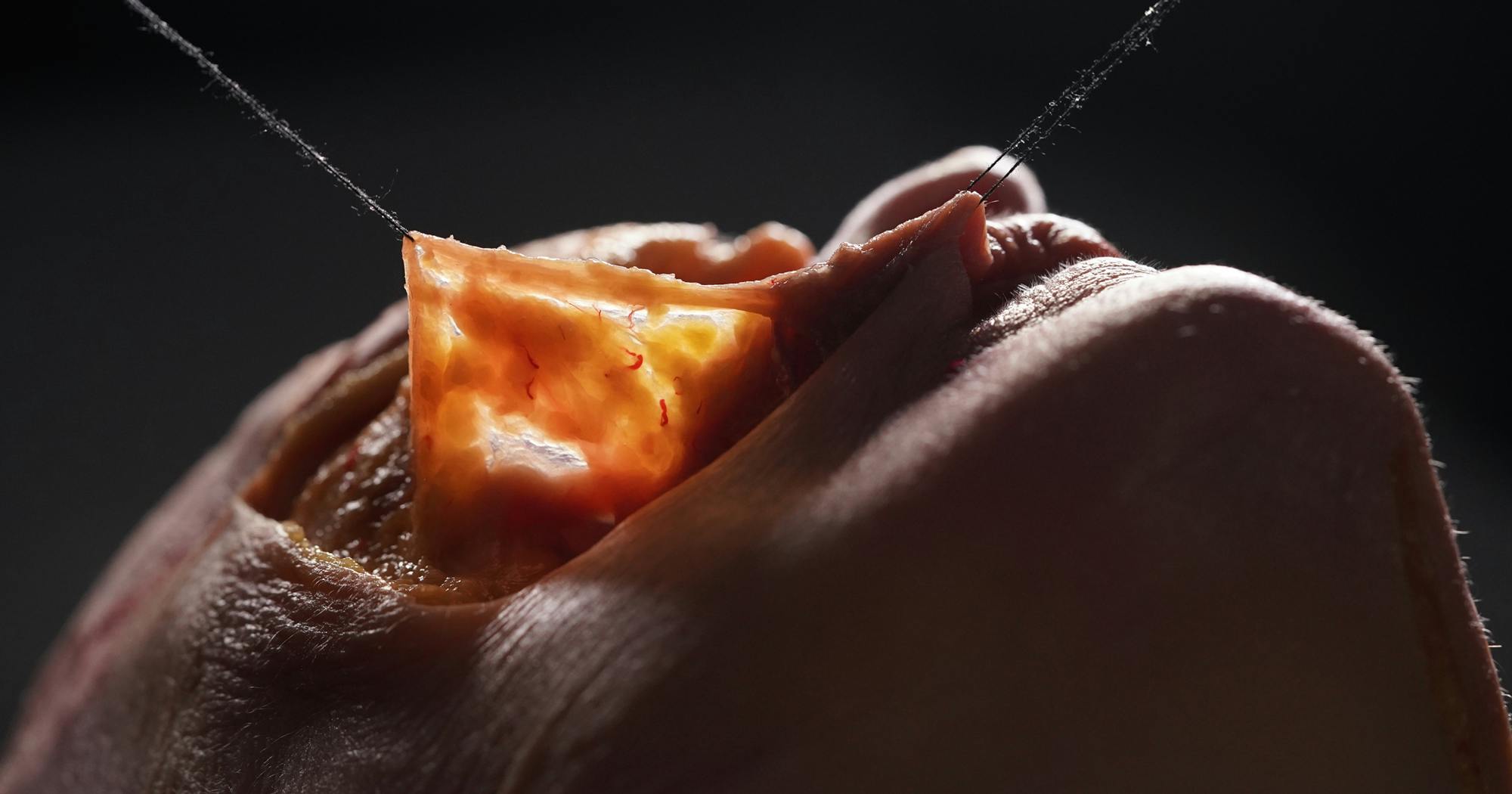
During the first detailed cadaveric facial dissections, which I performed in early 2013 and 2014, I realized that there were several structures in the face that had not been described. Particularly when performing a layer-by-layer dissection, some structures followed the standard and described anatomy, while other structures did not.
When I dissected the midface from lateral to medial, for example, I always had trouble isolating the zygomaticus major muscle in the area where the parotid duct and the facial vein traveled together.
During the deep approach, I ran into a connective tissue sheet that prevented me from dissecting and “cleaning” the facial vein from all its surrounding tissues to make the vein look pretty during anatomic demonstrations.
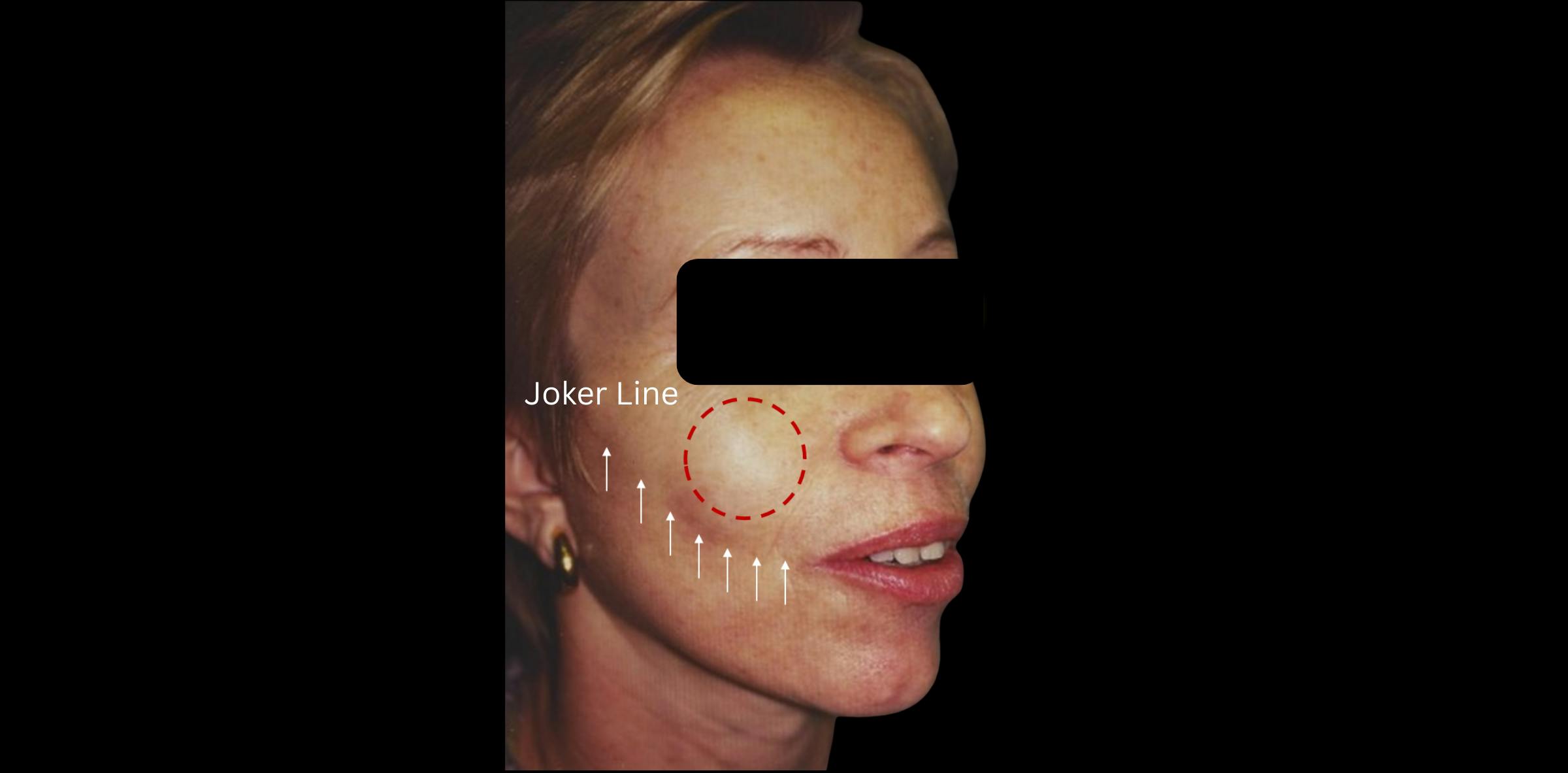
Three years later, I consulted with my dear friend and mentor Dr. Robert Gotkin (a great plastic surgeon and friend from New York City) about this issue, and he mentioned an interesting phenomenon that can occur after plastic surgery procedures: The Joker Line. This facial depression is visible in patients after face lift surgeries, and it is a sign when too much traction is applied to the SMAS during the repositioning and suturing steps. Above the joker line, there is a noticeably larger amount of visible volume, while below the line there is considerably less.
When examining this facial phenomenon, I couldn’t help but notice its similarities to the appearance of a smiling face, specifically the development of “apple cheeks.” Apple cheeks is a term used to describe the sudden increase in upper-midface volume that becomes prominent upon smiling.
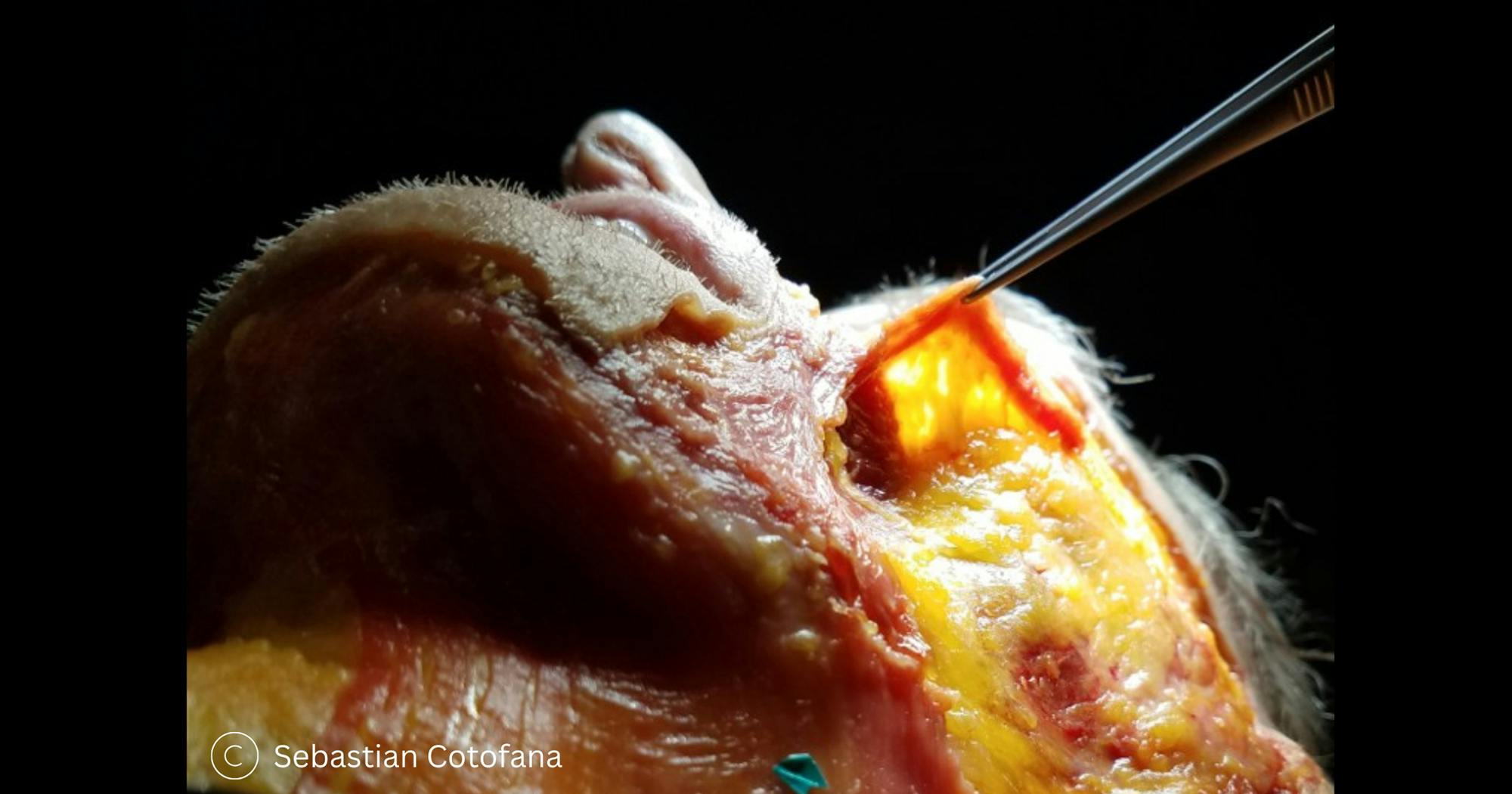
So, I went back into the anatomy laboratory and focused exclusively on dissections of the zygomaticus major muscle and on the unknown connective tissue sheet that always gave me trouble during my early dissections. After several attempts, I finally managed to isolate a connective tissue sheet that was connected on one side to the undersurface of the zygomaticus major muscle and on the other side to the maxilla of the midface.
When I manually moved the zygomaticus major muscle, I observed that this connective tissue sheet was pushing the deep and the superficial fat compartments of the midface upwards toward the upper cheek. I also realized that this sheet forms a firm boundary between the fat compartments of the midface and the buccal space below and that no midfacial fat could directly enter the buccal space due to this firm connective tissue boundary.
After consulting with many colleagues, including anatomists, plastic surgeons, ENT surgeons, and dermatologists, I decided to name this connective tissue sheet: The Transverse Facial Septum (I refused to call it the Cotofana Septum).
Soon after in 2019, my research team and I came out with a publication which introduced this structure for the first time in scientific literature (https://pubmed.ncbi.nlm.nih.gov/31688233/)
Based on this publication, the facial overfilled syndrome was better understood, and the term “dynamic filling” was coined by the aesthetic industry. The latter term describes the clinical procedure of having patients smile and performing various facial animations to identify if sufficient midfacial volume is present and to determine whether no more soft tissue filler product should be added to the midface during injectable treatments.
In 2020, we published another paper which described a sudden stop in venous flow of the facial vein while smiling ( https://pubmed.ncbi.nlm.nih.gov/31820574/) This finding was in exact alignment with the functional theory of the transverse facial septum, the zygomaticus major muscle, and the facial vein because the facial vein travels below the zygomatics major muscle and pierces through the transverse facial septum. And exactly in this location, the facial vein can be compressed when the zygomaticus major muscle is contracted. In other words, when we smile, we contract the zygomaticus major muscle, and this muscle can compress the facial vein and thereby obstruct the venous outflow from the face.
Similarly, when too much traction is applied to the SMAS during face lift surgery, the zygomaticus major muscle is also placed under traction because this muscle becomes integrated into the SMAS in the anterior midface. Traction on the zygomaticus major muscle results in a tensed transverse facial septum which pushes the midfacial fat compartments upwards. This results in a volume increase in the upper midface and in a volume decrease in the lower midface; the clinical presentation of this is the joker line following face lifting surgeries.
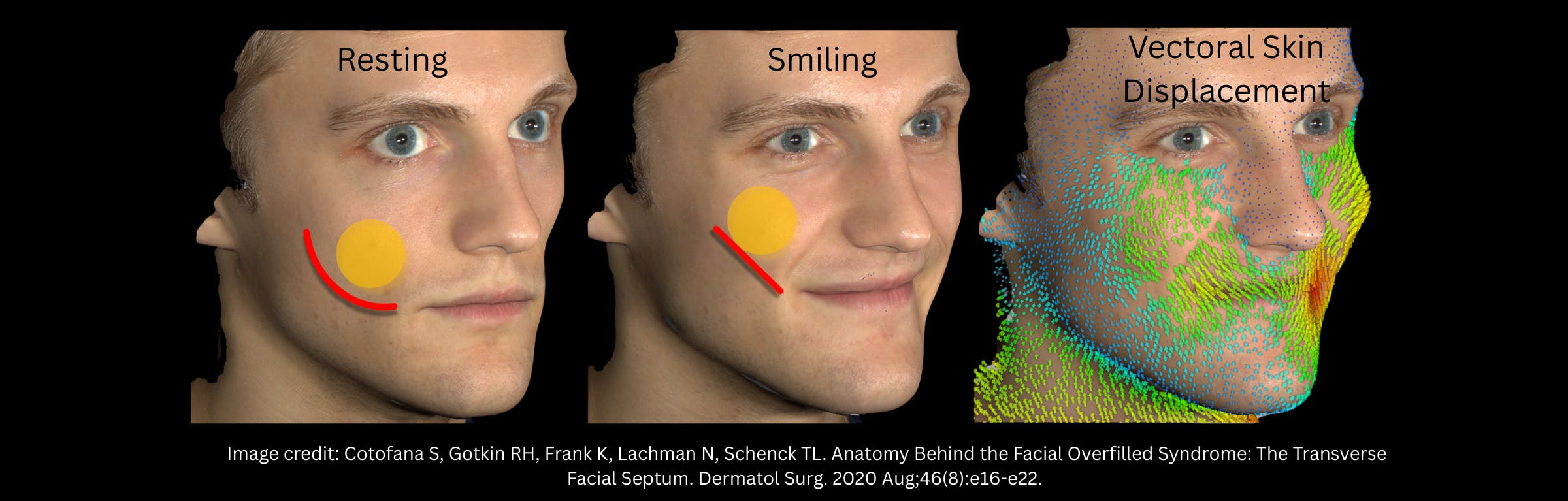
For minimally invasive aesthetic procedures like filler injections, this means that under resting conditions (when we don’t smile), the midfacial fatty volume is resting in a lower facial position like in a loose and relaxed hammock. This relaxed hammock is represented by the transverse facial septum. Upon smiling, the zygomaticus major muscle contracts and the transverse facial septum tenses. This changes the conformation of the transverse facial septum from the previously loose hammock to a tense and stiff connective tissue sheet. This change results in the elevation of the midfacial volume from low to high in the midface, which is visible as apple cheeks on the skin surface. If filler material is injected into a resting midface, more volume will be applied until a skin surface effect is visible. But when the patient is asked to smile, the true midfacial volume becomes easier to appreciate because no volume remains hidden in the midface. This process of “dynamic filling” helps to prevent the facial overfilled syndrome and results in reduced amounts of filler material in the midface.
I would like to thank all of my friends and colleagues who helped and supported the process of the discovery of the transverse facial septum and its clinical applications.
Join our community for news, offers, and updates on Cotofana Anatomy’s events and resources
Copyright © 2026, Cotofana Anatomy. All rights reserved.